When I work with an organisation that’s new to my approach to OKRs, there’s a moment I’ve learned to watch for.
Someone suggests an OKR designed to test a hypothesis. I’m delighted. This is what I’m looking for. Nobody says no. But nobody says yes either. I sense a hesitation.
What I’ve realised they’re not saying is: “What happens when we miss this goal?” My answer: it depends on which job the OKR is doing.
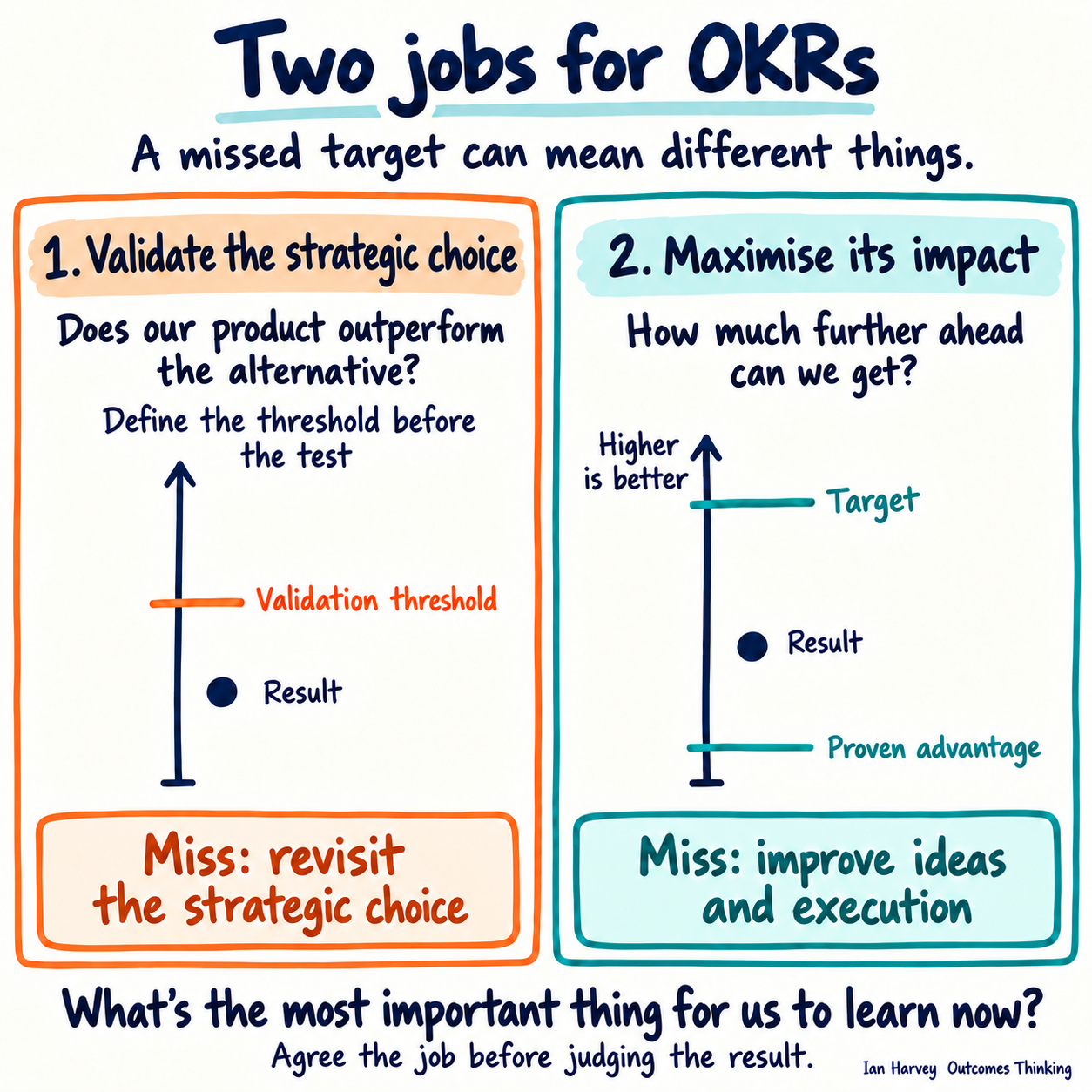
OKRs can do two useful jobs, but we have to be purposeful about which.
The first is validating our strategic choices. The second is maximising the impact of choices we’re confident in. The hesitation usually comes from an OKR that's doing the first job.
One organisation I was working with had landed on their riskiest strategic assumptions. The most fundamental thing was whether the product outperformed what their customers were already doing.
The OKR they needed to write would help them test and learn about their strategy, my first job for OKRs. At first, I saw the same hesitation. I pointed out that it was crucial they learnt whether that assumption held, whichever way the answer went. What leaders needed to explain was that the outcome was not a judgement of the team's performance. It was a judgement of the strategy itself.
The key thing I insisted on was making sure they defined what a positive validation of the strategy would look like. When we’re testing something we care about, we tend to bend the evidence to get the answer we want. It’s harder to do that when we document our success and failure conditions in advance.
If, despite best efforts, the hypothesis fails, they learn an important thing. The core idea about how they create advantage needs revisiting. Without creating an OKR to measure a falsifiable hypothesis, they could end up iterating on an idea that will never work.
Fortunately, the strategic hypothesis held, but it was still important to increase the distance between the product and the incumbent solution. Measuring their success in achieving this is an example of the second job for OKRs.
The aim was to widen that gap as far as possible, and it was quite straightforward for them to write an OKR to track that. The challenge for the team was to iterate on their ideas to have the maximum impact. Falling short on this OKR would teach the team about the quality of their ideas and execution, but it wouldn't lead to a change in strategy.
So when I sense that hesitation, I ask: “What’s the most important thing for us to learn now?” This dictates what job the OKR is doing and how we respond if there's a miss. It’s where leaders have to earn the team’s trust.
What would your teams test if they knew a miss wouldn’t count against them?