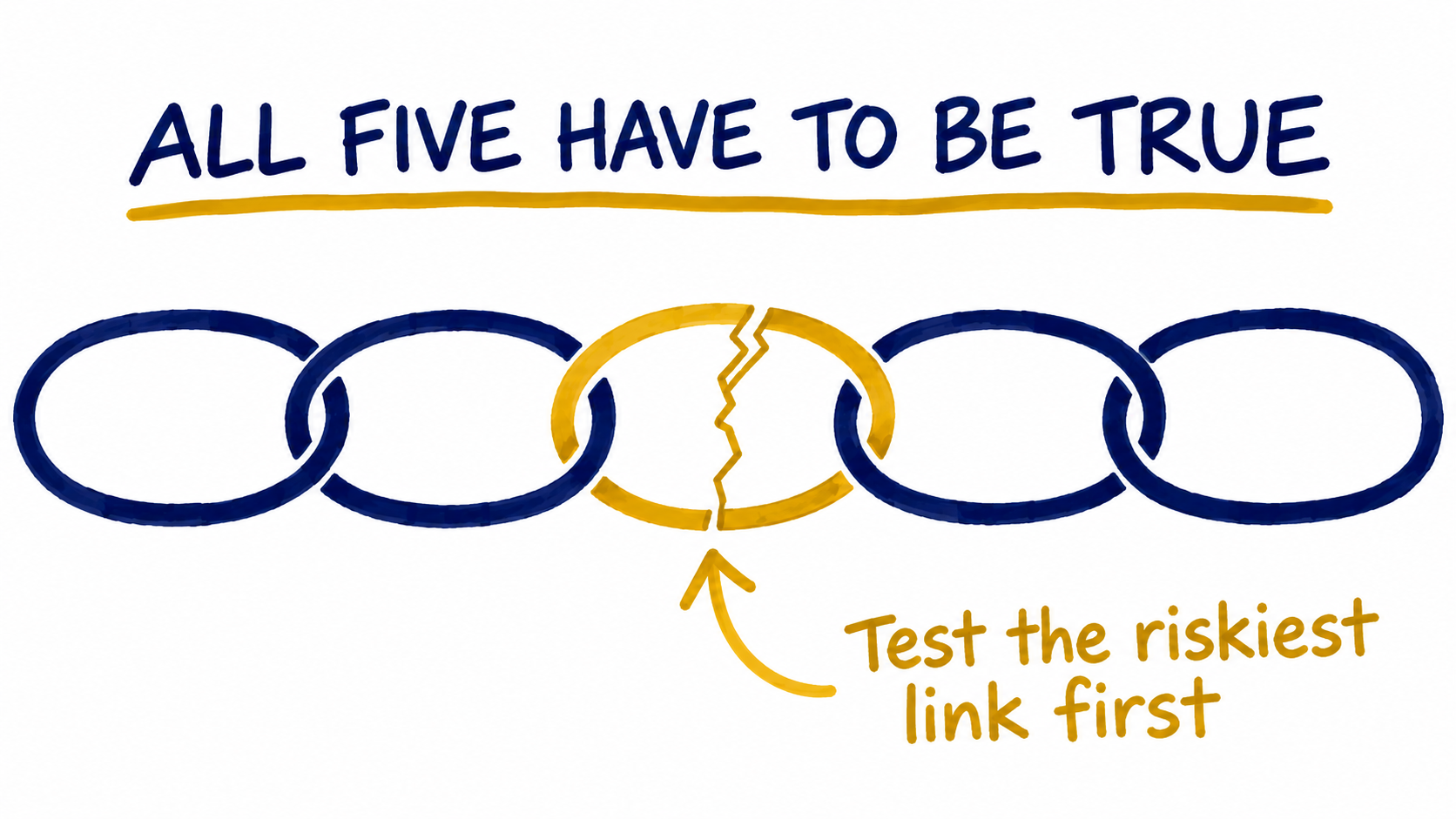
There is no certainty in business. Everything you have is essentially a hypothesis. When you embrace this, you accept that the things you're doing are really bets. But the truth is, for most bets, it's not a simple single question. You're really building a set of connected hypotheses, a series of things that have to be true for your bet to work.
This summer I ran OKR sessions with product teams at a fintech. To explain what I mean by a bet, I used an example. It was illustrative, not their actual plan, but close enough to their world to land.
The bet
Say you run a consumer finance app. You want to grow customer lifetime value. Your idea is to let existing customers trade stocks inside the app. It sounds like one idea. Do customers want this, yes or no?
Look closer and there are (at least!) five.
The chain underneath
For this bet to work, all of these have to be true:
- Our existing customers will buy more products from us.
- They want to trade stocks, and they don't have a good way to do it today.
- They trust us enough to pay us for it.
- We can build and run it profitably.
- We can make it something they actually want to use.
Each one is an assumption. Each one could be wrong. If any single link breaks, the whole bet breaks with it.
Customers might love the idea and refuse to pay. They might pay, while the cost of running it eats the margin. It might all stack up on paper and still be too clunky to use.
Testing the chain
So we wrote one OKR: show that customers want to trade stocks through us.
Three key results sat under it:
- Transaction volume
- The number of repeat traders
- A minimum fee per trade
Together they test several links at once. Volume tells you people are interested. Repeat traders tell you it's usable and worth coming back to. The fee tests something else.
The question someone asked
Someone asked why a fee counted as a key result. It looked like a pricing detail.
It's there because of link three. If trades were free, we could hit every volume target and still learn nothing about whether there's a business. Free tells you people like it. Only a price tells you they'll pay.
I call this a balancing or guardrail key result.
Why the chain matters
Treat a bet as a single question and failure tells you one thing: it didn't work. That's almost useless.
Map the chain and failure tells you which link broke. That changes what leadership does next:
- Continue, because the evidence is building.
- Adapt, because one link is weak but fixable.
- Stop, because a core assumption is wrong.
- Park it, because the timing is off. Maybe nobody associates you with investing yet. Come back in a year with a bigger customer base.
This is the other half of a bet. Teams learn which links hold. Leaders use that learning to make better strategic decisions, sooner.
Close
The big mistake teams make is to build the whole thing, launch it, market it and just review the headline number.
It's cheaper to identify the riskiest link in your chain and find a way to test it without building the whole thing.
So take your biggest current bet. Write down everything that has to be true for it to work. Then ask which of those links you've actually tested and which link you should test first.